 Image 1 of 1
UAN 32 (urea ammonium nitrate solution, 32% nitrogen) — overview and application in agriculture
What it is
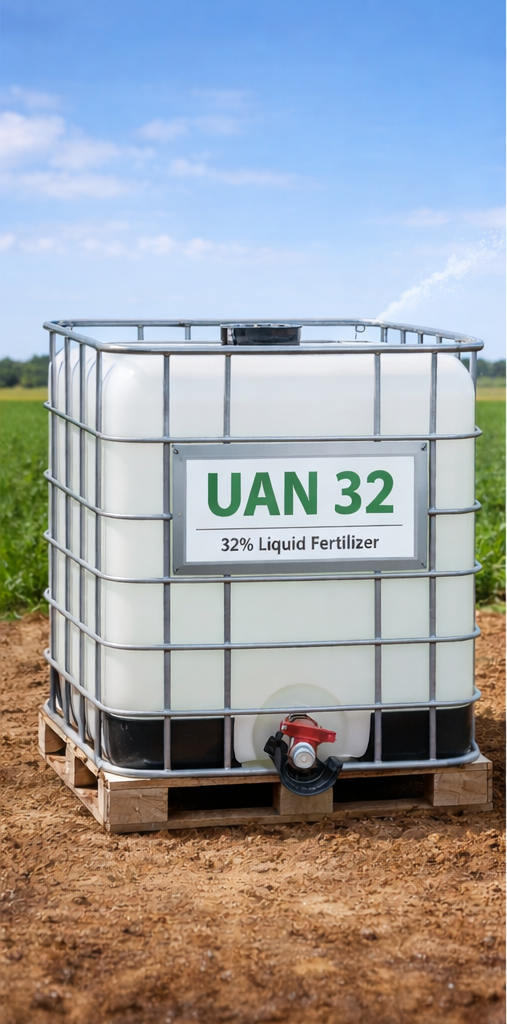
UAN 32 is a liquid fertilizer containing 32% total nitrogen by weight, supplied as a homogeneous solution of urea, ammonium nitrate, and water.
Typical formulation: roughly equal proportions of urea-N and ammonium-N with some nitrate-N; exact ratios vary by manufacturer.
Physical properties: clear to slightly amber liquid, free-flowing at normal storage temperatures; freezes around 0°F to 10°F depending on formulation and additives.
Benefits
Versatility: can be applied by ground or aerial equipment, through fertigation (irrigation systems), or as a foliar spray when diluted appropriately.
Uniform nitrogen source: delivers ammonium and nitrate forms that provide both immediate availability (nitrate) and short-term residual (ammonium, urea after hydrolysis).
Handling and logistics: liquid form simplifies blending with herbicides, pesticides, micronutrients, and other additives (compatibility must be checked).
Cost-effectiveness: often less expensive per unit of N than some dry fertilizers when accounting for application efficiencies.
Safety, storage, and handling
Corrosive to some metals and can degrade certain plastics and rubber materials; use materials rated for UAN storage and handling.
Store in well-ventilated, temperature-stable tanks; avoid freezing and prolonged exposure to high heat.
Personal protective equipment: chemical-resistant gloves, goggles/face shield, and protective clothing during mixing and application.
Spills: contain and recover; avoid release to waterways. Neutralization is not typical — absorb and dispose per regulations.
Transportation and regulations: subject to local and federal regulations governing nitrogen fertilizers and hazardous materials; follow labeling and safety data sheet instructions.
Calculations and conversion quick reference
Approximate nitrogen content: 32% N by weight.
Pounds of N per gallon (UAN 32): ~2.8 lb N/gal (density varies; use supplier density for precision).
To convert desired lb N
UAN 32 (urea ammonium nitrate solution, 32% nitrogen) — overview and application in agriculture
What it is
UAN 32 is a liquid fertilizer containing 32% total nitrogen by weight, supplied as a homogeneous solution of urea, ammonium nitrate, and water.
Typical formulation: roughly equal proportions of urea-N and ammonium-N with some nitrate-N; exact ratios vary by manufacturer.
Physical properties: clear to slightly amber liquid, free-flowing at normal storage temperatures; freezes around 0°F to 10°F depending on formulation and additives.
Benefits
Versatility: can be applied by ground or aerial equipment, through fertigation (irrigation systems), or as a foliar spray when diluted appropriately.
Uniform nitrogen source: delivers ammonium and nitrate forms that provide both immediate availability (nitrate) and short-term residual (ammonium, urea after hydrolysis).
Handling and logistics: liquid form simplifies blending with herbicides, pesticides, micronutrients, and other additives (compatibility must be checked).
Cost-effectiveness: often less expensive per unit of N than some dry fertilizers when accounting for application efficiencies.
Safety, storage, and handling
Corrosive to some metals and can degrade certain plastics and rubber materials; use materials rated for UAN storage and handling.
Store in well-ventilated, temperature-stable tanks; avoid freezing and prolonged exposure to high heat.
Personal protective equipment: chemical-resistant gloves, goggles/face shield, and protective clothing during mixing and application.
Spills: contain and recover; avoid release to waterways. Neutralization is not typical — absorb and dispose per regulations.
Transportation and regulations: subject to local and federal regulations governing nitrogen fertilizers and hazardous materials; follow labeling and safety data sheet instructions.
Calculations and conversion quick reference
Approximate nitrogen content: 32% N by weight.
Pounds of N per gallon (UAN 32): ~2.8 lb N/gal (density varies; use supplier density for precision).
To convert desired lb N